
• Link to Facebook
  • Link to X
  • Link to Youtube
Saint Paul Bird Alliance
  • About
    • Who We Are
    • Chapter Leadership
    • Annual Reports
      • 2024-2025 Annual Report
      • 2023-2024 Annual Report
      • 2022-2023 Annual Report
      • 2021-2022 Annual Report
      • 2020-2021 Annual Report
      • 2019-2020 Annual Report
    • Finances
      • 2022-23 Financial Summary
      • 2023-2024 Financial Summary
      • 2025 – 2026 Budget
    • Board Minutes
      • Board Minutes 2024
        • Jan. 2024 Board Minutes
        • Feb. 2024 Board Minutes
        • March 2024 Board Minutes
        • April 2024 Board Minutes
        • May 2024 Board Minutes
        • Sept. 2024 Board Minutes
        • Oct. 2024 Board Minutes
        • Nov. 2024 – Board Minutes
        • Dec. 2024 Board Minutes
      • Board Minutes 2025
        • Jan. 2025 Board Minutes
        • Feb. 2025 Board Minutes
        • March 2025 Board Minutes
        • April 2025 Board Minutes
        • May 2025 Board Minutes
        • May 2025 Annual Meeting and Election Board Minutes
        • Sept. 2025 Board Minutes
        • Oct. 2025 Board Minutes
        • Nov. 2025 Board Minutes
        • Dec. 2025 Board Minutes
      • Board Minutes 2026
        • Jan. 2026 Board Minutes
        • Feb. 2026 Board Minutes
        • March 2026 Board Minutes
        • April 2026 Board Minutes
  • Events
  • Get Involved
    • Volunteer
    • St. Paul Bird Alliance Membership
    • Join National Audubon
  • Grants
    • Applying For A Grant
    • Grants in Action
  • Conservation Action
    • American Kestrel Nest Box Monitoring
    • Battle Creek Properties at Risk
  • News
    • News Blog
    • Archive: Newsletter
    • Subscribe
  • Contact Us
  • Click to open the search input field Click to open the search input field Search
  • Menu Menu

Spring, the Singingest Season
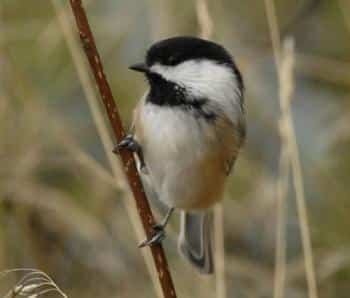
Black-capped Chickadee

Black-capped Chickadee
Photo credit: Jim Williams

 
by Val Cunningham
Contributing Writer

Chickadees and cardinals sing lilting songs, but their meaning may be in the ear of the beholder

The bird-song orchestra is tuning up for spring. House finches chortle from treetops, goldfinches sing loudly from perches and sparrows twitter loudly in shrubbery.

Two of the most persistent songsters at this time of year are the familiar northern cardinal and black-capped chickadee. These birds are fairly circumspect during the winter but now are bursting forth in exuberant song.

During the cold months cardinals seemed relatively indifferent to other cardinals. They gathered in groups of a dozen or more at good sources of food or water without raised crests or other threatening behavior. Chickadees spent the winter together in flocks, sharing the news when one discovered a good cache of insect eggs or berries.

But the time for peaceful coexistence is over. With spring approaching and hormones ramping up, resident songbirds now are sending out songs either to cajole or threaten. Male chickadees sing “fee-bee” to entice a female to leave the flock and set up housekeeping. That same call, whistled more loudly by a male, can also mean, “Stay away from this side of the yard, buddy!”

The cardinals filling the brisk spring air with their exuberant “wha-cheer” song are engaging in early courtship behavior, too, but with a twist: both males and females are singing, unusual in the world of songbirds. Cardinal pairs sing duets, burbling “purdy, purdy, purdy, wheet, wheet, wheet,” back and forth, before moving on to other combinations in their repertoire. While songs in early spring are part of the courtship ritual, they later become aural fences, spilling out a cardinal pair’s sense of the territory it intends to defend.

Spring is really all about territory, since this is a major factor in determining how many young birds survive to leave the nest. The two vital characteristics of a good territory are plenty of insects to feed nestlings and plenty of shrubs and trees for hiding from predators.

Cardinals, chickadees and other “winter” birds will have carved up the local real estate by the time migratory birds begin returning in May. As migrants flood in, hurrying to find a mate and establish their own territories, do they have to settle for whatever space is left?

Mother Nature has thought this out. Songbirds sing to entice or warn to their own kind: cardinals don’t want other cardinals setting up housekeeping nearby, invading the niche they’ve carefully cultivated. Same for chickadees, who worked hard to find a nice tree hole and don’t want other chickadees invading their space.

But cardinals and chickadees don’t much care what other species are doing. They’ll tolerate orioles when these arrive, warblers when they dash through and bluebirds on the hunt for beetles. These other species have their own particular food and nest specifications and are not regarded as competitors by our resident birds.

During the busy nesting season, when birds drive themselves almost to exhaustion, they sing less often and more softly. These “pianissimo” songs of cardinals and chickadees may be telling a mate that they’re bringing food in to the nest.

Birds must learn the songs sung by their species, so the sounds of late summer and fall are often uttered by youngsters practicing the same notes over and over until a song matches their mental template. Like a kid learning to play the violin, these sounds can be discordant, until, with practice, they become music to our ears.

St. Paul, Minnesota resident Val Cunningham, leads bird hikes for the St. Paul Audubon Society and writes about nature for local, regional and national newspapers and magazines.

Bird Spotlight

  • Red-Bellied WoodpeckerJanuary 29, 2014 - 5:42 pm
  • 8 Ways to Help BirdsDecember 29, 2013 - 5:20 pm
  • The Squeaky Bird of the ForestNovember 16, 2013 - 7:20 pm
  • Bird World Changes With the SeasonsOctober 16, 2013 - 7:48 pm
  • A River of Birds Stream by at NightSeptember 16, 2013 - 8:19 pm
  • Male Rose-breasted Grosbeak
    Grosbeaks are the Bandana BirdJuly 19, 2013 - 7:26 pm
  • Indigo Bunting
    Blue Indigos Catch the Eye — and EarJuly 19, 2013 - 7:12 pm
  • Very young red-tailed hawks
    Nest Cams Put You in the Catbird SeatJune 19, 2013 - 7:40 pm
  • Great-horned Owl
    It’s Hooting Season for Great-Horned OwlsFebruary 19, 2013 - 7:48 pm
  • male Pine Grosbeak
    Watch for Handsome, Hungry Winter FinchesJanuary 19, 2013 - 8:02 pm
  • White-breasted Nuthatch
    Birds Triumph Over the ColdDecember 20, 2012 - 6:47 pm
  • Downy Woodpecker at suet feeder
    Downies, the Pocket-Sized WoodpeckersNovember 20, 2012 - 6:54 pm
  • Scarlet Tanager
    Birds Eating WeirdlyOctober 20, 2012 - 7:22 pm
  • Sandhill Crane
    Cranes families are on the moveSeptember 20, 2012 - 7:35 pm
  • Pair of prothonotary warblers
    Songs subside as birds rear their youngJuly 20, 2012 - 7:45 pm
  • Blue Jays hash it out at feeder
    Blue Jays Get a Bad RapJune 21, 2012 - 3:25 pm
  • Tree Swallow nest
    The Incredible EggJune 21, 2012 - 3:21 pm
  • Male goldfinch feeds young
    Nature’s TurncoatsMay 21, 2012 - 3:32 pm
  • great horned owl
    Night’s silent hunters may live in your ‘hoodApril 21, 2012 - 4:07 pm
  • White-throated Sparrow
    Beautiful Springtime MusicApril 21, 2012 - 3:45 pm

Saint Paul Bird Alliance
P.O. Box 7275
St. Paul, MN 55107

Saint Paul Bird Alliance is a chapter of the National Audubon Society, Inc.

Donate to Saint Paul Bird Alliance >

Subscribe to The Cardinal newsletter >

Upcoming Events >

Contact Saint Paul Bird Alliance >

© Copyright - Saint Paul Bird Alliance 1945 - 2024. All Rights Reserved. | Powered by simpleDesigns
  • Link to Facebook
  • Link to X
  • Link to Youtube
Link to: April/May 2010 Link to: April/May 2010 April/May 2010 Link to: Big, Bright Birds Link to: Big, Bright Birds Baltimore OrioleBig, Bright Birds
Scroll to top Scroll to top Scroll to top